AI Engineering Weekly Issue 46
Issue 46 · November 12, 2026 · Covering 2026-11-05 to 2026-11-12
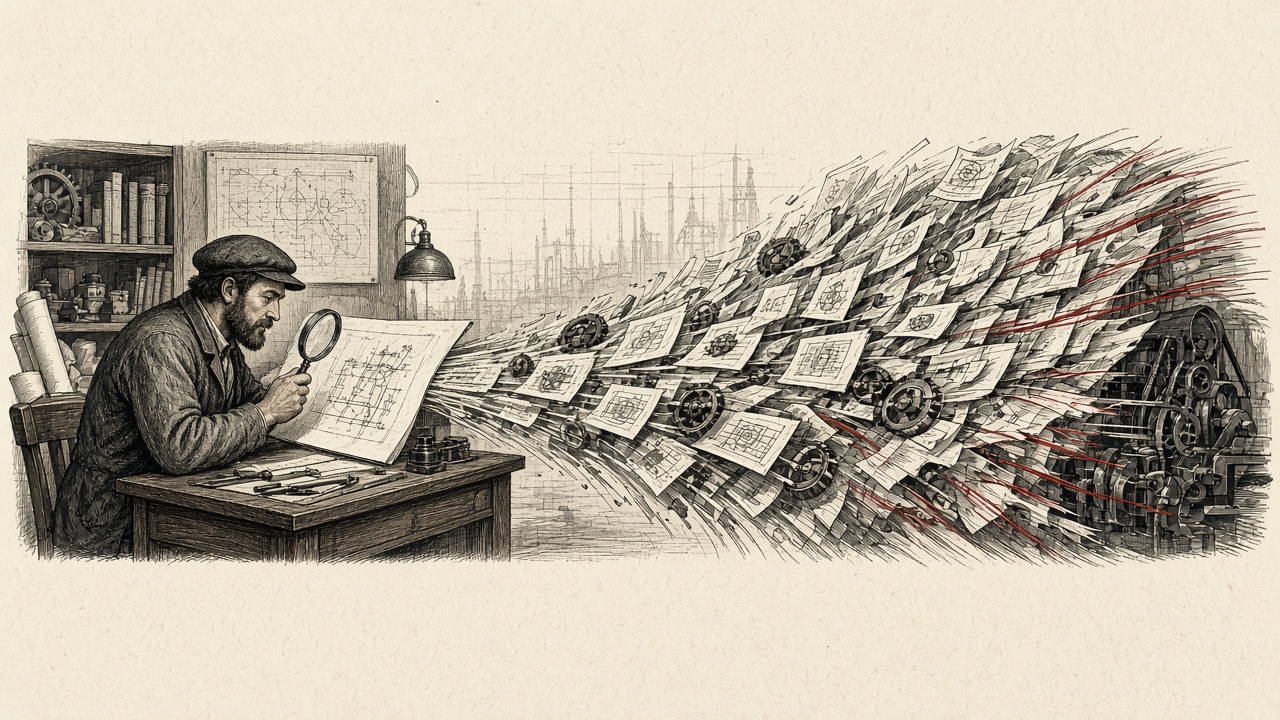
AWS let agents write a full local emulator while engineers built the spec, the tests and the merge gate
The local emulator that AWS released has no code written by people. People built the spec, the tests and the merge gate.
The emulator gives coding agents a local copy of AWS to test against. Agents wrote and tested all of its code from more than 400 public API models that cover more than 200 services. The agents first correct each test until it passes against real AWS. Then they change the emulator until it passes the same test.
An agent can only verify code for distributed systems inside infrastructure, so it needs an environment that behaves like the real services. AWS executive Swami tells his own lesson. He used Kiro to rebuild a replication engine that first took about 4 months. He supervised the agent for four nights before he saw that it could not check its results. With a spec and a test environment, the rebuild took about 2 hours.
The engineer's job becomes three tasks: write the spec, build the tests and set the merge gate. The AWS merge gate has several security agents that each review a change for different attacks. Deterministic checks stop agents from touching code outside their task. The repository shows the full commit history and every issue the agents filed, including behaviors that do not yet match real AWS. AWS says this way of working is still early.
"However fast an agent writes, something must tell it whether the work is correct."
— Theme of the week
METR report: capabilities progress at Anthropic ran about twice as fast over the past year
The evaluation group METR investigated Anthropic. It concluded that capabilities progress there ran about twice as fast as the year before, mostly because AI now helps with AI research. A METR researcher then estimated that each researcher needs an uplift of about 10x for the whole organization to double its pace.
▸ Click to expand
A team that doubles its pace needs a much larger speedup per person, because experiment compute does not grow at the same rate. The author's simple model gives 4x to 9x, and ideas that get harder to find push the estimate to about 10x. Anthropic staff informally report about 12x. The public report redacts most of its evidence, so outsiders cannot check it.
When you estimate a speedup from AI, calculate the per-person speedup and the team output separately. Find the steps that do not speed up with people, such as experiment compute or review, and measure those first. When you cite this report, say that the key evidence is not public and that the estimates are the author's own opinion.
A former Meta engineer says a codebase written mostly by AI becomes more fragile
A former Meta engineer says that when a team relies on AI for all its code, the codebase slowly becomes fragile and incidents increase. He names four causes: shallow tests, code that is too complex, people who no longer understand the code, and review that cannot keep pace. This is one person's observation, and the post gives no incident data.
▸ Click to expand
Line coverage does not show these problems, so teams often find them only after incidents increase. The author says AI generated at least 90% of his code in his last months at Meta, which was the minimum for a decent rating. When the agent cannot find the cause of an incident, people must search code they do not know, so recovery takes longer.
Record incident counts and recovery time each month, and compare them with the date the team moved to agent-written code. In test review, check which types of users the tests cover, not only line coverage. Assign people to read the core modules on a schedule.
Scientists rank ideas and data gathering first, but rarely give those tasks to Claude
Anthropic analyzed about 207,000 research sessions and found that scientists mainly use Claude to analyze data and to write. They use it less for the two tasks they rank most important: idea generation and data gathering. The reasons differ. Data gathering is often physical. For ideas, scientists may prefer to do the work themselves, or the model may be weaker.
▸ Click to expand
Teams that build research tools or internal research agents can see that usage follows what the model can do, not how important the task is. Data analysis is 48.1% of research sessions on Claude Code and 27.6% of researcher time. Data gathering takes 28.6% of researcher time but only 11.5% of sessions on Claude.
When you build a research tool, connect the separate databases and tools into one workflow first. Idea generation has a larger share on specialized tools. To estimate how much a field can speed up, first calculate the share of time that goes to physical steps. When you cite the report's acceleration multiples, say that they are scenarios and not forecasts.
Agents found a Maya site in lidar data in three days, but archaeologists had already mapped it
A developer with no archaeology training had agents analyze public lidar data. In less than 72 hours they found a Maya site that was not in the official register. After he published, he added a correction: a 2025 paper had already mapped the site, and the agents missed it in the literature search.
▸ Click to expand
Agents are good at reading images one at a time against a guide. They easily miss prior work when the claim is that nobody did this before. 48 agents turned about 1,200 km² of NASA jungle data into images and examined each one, with no special model. Mexico's National Institute of Anthropology and History replied that its register had no site at that location. A site that is absent from the register can still appear in a paper.
When an agent must decide whether something is new, make it list the papers and databases it searched. Search official registers and academic literature separately. Ask a person in the field to review the result before you announce a discovery.
A research-agent builder removed the planner and stopped starting a subagent for every search
The author of TinyFish's research agent changed two parts of the design, and the system became faster and cheaper. He removed the separate planner because it started from a snapshot each time and lost information in the handoff. He also stopped starting a subagent for each search, because ranking results and extracting claims are not judgment calls. They became plain tool calls.
▸ Click to expand
Teams that build multi-agent systems often give every step to an agent by default, and this post is a counterexample. On a follow-up that asked only about pricing risks in Southeast Asia, the old planner drifted back to the whole market. The author ran the three public benchmarks himself. One result is 51.74 out of 100 on DRACO.
Examine each step of your workflow, and change every step that needs no judgment into a plain tool call. Keep planning in the same context that followed the whole task. Set a ceiling on steps and time for every run, and write the report from the collected material when the run reaches it.
Twenty parallel agent sessions exhausted one developer, so he moved the work into a queue in git
A developer found that with about 20 agent sessions open at once, he could no longer remember what he was doing. He now writes every task as a Markdown ticket in the repo, and an agent works the board in cycles. Everything that needs his decision goes to one inbox. He takes one item at a time, decides, and puts it back in the queue.
▸ Click to expand
For people who run several coding agents from the terminal, the limit is often their own attention. Each reply forces them to load the context again. In his setup the agent researches, builds and runs tests, but it never deploys to production. The author says the work is still exhausting, and tickets can stall while they wait for his ruling.
Keep task state in the repo, not in a chat window or in your head. Have a script sort the items that wait for a human decision into one prioritized list. Open one item at a time, write the decision back to the ticket, then take the next one.
Anthropic: let the model decide what to remember, then use idle time to check the notes
Anthropic found that newer models do better when they decide what to remember than when they follow fixed rules. Older models saved everything, their notes went out of date quickly, and the memory slowed the task. Anthropic also has the model check and reorganize its notes against the original transcripts during idle time. It calls this step dreaming.
▸ Click to expand
Teams that build long-term memory for agents can write fewer memory rules and spend compute on later checks. In Pokémon, an older model wrote 413 memory files and earned 1 badge. The newest model wrote 9 files and earned 4. With a rule to record only failures, two Opus models lost much of the gain that memory gave them. Anthropic ran all of these tests on its own models.
Tell the model what memory is for, not how to use it. Have the agent check its notes against the original session transcripts on a schedule and correct the wrong entries. Keep the memory layer that loads into every session small. Move details down and leave links.
Every agent tool has its own memory format, and none can read the others
The author of LoreKit says each agent tool stores memory in its own format, so a lesson one agent learns does not reach another. He proposes that the field agree on a shared data model first, as observability did when two projects merged into OpenTelemetry. He builds a memory tool himself and says so in the post.
▸ Click to expand
A team that runs a CI agent, an editor agent and a review bot in one repo cannot give them one shared memory today. The post lists 9 families of formats with different rules for forgetting. Copilot, for example, deletes a memory after 28 days without use. The author accepts the strongest objections: one more standard may not reduce fragmentation, and shared memory is a channel for prompt injection.
List every place where your team's agents store memory, and find which ones cannot read each other. For each memory, record who wrote it, when it expires and which record it replaces. Treat shared memory as untrusted input, and check that the code it refers to has not changed before you use it.
Google donated its agent orchestrator and sandbox to the CNCF, with a wake time under half a second
Google says Kubernetes is a poor fit for agents. An agent waits for a model or a person most of the time, but you cannot stop it. It donated a new orchestrator, Agent Substrate, and the gVisor sandbox to the CNCF. The design separates session state from compute. It saves the state when the agent is idle and restores it onto a warm machine when a request arrives.
▸ Click to expand
Teams that run their own agent platform must choose between two poor options. They pay for idle machines all day, or they scale to zero and accept slow starts. Google says an agent waits for 90% to 95% of an interactive session. Wake time from cold storage is more than 20 seconds, and Substrate targets less than 500 milliseconds. These are the vendor's own numbers, and the post has no independent test.
Measure how much time your agents spend idle before you decide to change the scheduler. Do not let model-generated code share a kernel with the host. If batch evaluation must start thousands of sandboxes at once, check that the control plane can carry the load.
Most of the ten articles in this issue answer one question: after the agent finishes, who confirms that the work is correct? AWS uses a spec, tests and a merge gate. The Maya site is the counterexample: the agents read the images well but missed one paper, so a discovery became a rediscovery. Anthropic has the model check its notes against the original transcripts. The fragile codebase that a former Meta engineer describes is what happens when checks cannot keep pace with generation. One question to ask of your own system: does every type of agent output have a check that the agent can run itself?