Orbital Data Centers: Who Supplies the Chain, and Who Keeps the Money
Key Takeaways
- Orbital compute is still a demonstration market. Google's first four-TPU prototype reached orbit on 2026-10-01. No listed company reports orbital compute revenue. Our estimate puts external spending at tens of millions of dollars a year today.
- The cost gap is about 3x to more than 4x. Full-system models from SemiAnalysis, IEEE Spectrum and Wood Mackenzie put orbit at three to more than four times the cost of a ground data center. SemiAnalysis puts base-case parity near 2040.
- SpaceX is both the launch monopolist and the largest would-be operator. It lifted more than 80% of global mass to orbit each year since 2023. It also builds its own buses, solar cells and laser links.
- Value goes to compute silicon and to integrators. By our rough count, chips are about $21–40B of every gigawatt. Integrators build radiators and solar panels in-house, so most power and thermal value never reaches a merchant supplier.
- For merchant suppliers, orbital compute is optionality, not earnings. Rocket Lab, Redwire, Planet Labs and Intuitive Machines have the best fit. We estimate their exposure below 2% of revenue today and 2–10% by 2030.
1. What an Orbital Data Center Is
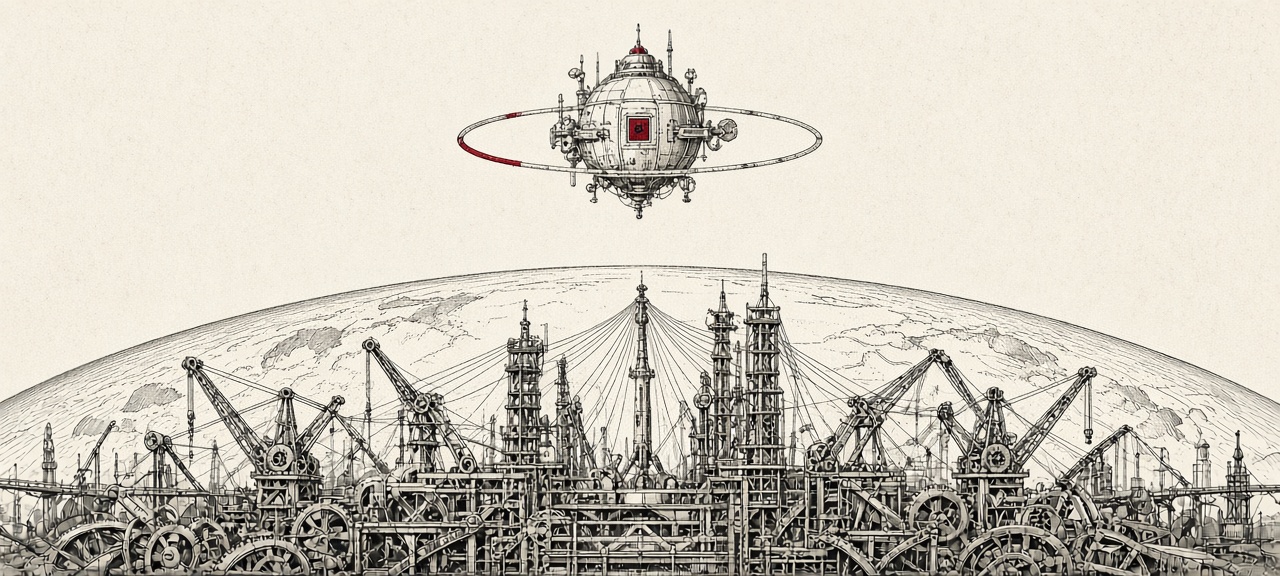
An orbital data center puts AI accelerators on satellites. Solar arrays power them, radiators reject their heat, and laser links connect them to each other and to the ground. The usual orbit is a dawn-dusk sun-synchronous orbit, where the arrays see the sun almost all the time.
The pitch rests on three claims:
- A solar panel in the right orbit produces up to 8 times more energy than the same panel on the ground (Google Research, 2025-11-04).
- Orbit avoids grid interconnection queues, land permits and local opposition.
- Launch costs will keep falling as Starship matures.
The counter-claims are just as concrete. Heat leaves only by radiation, so radiators get large. Nobody can repair the hardware, so satellites are disposable on a five-year life. Radiation corrupts memory and logic.
2. Economics From First Principles
2.1 The $200/kg Threshold Covers Electricity Only
Google's Suncatcher paper (arXiv 2511.19468) compares the launch cost per kilowatt of satellite power with the cost of ground electricity.
| Launch price to LEO | Launched power cost ($/kW/yr) | Ground power cost ($/kW/yr) |
|---|---|---|
| $3,600/kg (Falcon 9 today) | about 14,700 | 570–3,000 |
| $200/kg (Google's mid-2030s projection) | about 810 | 570–3,000 |
At $200/kg, launch matches the electricity bill. That comparison leaves out the spacecraft itself. Space engineer Andrew McCalip says satellites cost "almost $1,000 a kilo right now" (TechCrunch, 2026-02-11). It also leaves out the five-year life and the cost of radiation errors.
Electricity is only one line of an AI data center's cost. Chips, buildings and networking make up the rest. Jeff Bezos made the same point: energy must become a bigger share of data center cost before orbit pays (CNBC, 2026-05-20). Orbit saves money on the electricity line and adds launch, bus, radiator and reliability costs.
2.2 Full-System Models
| Source | Orbit vs ground | Parity view |
|---|---|---|
| SemiAnalysis (2026-06-03) | $8.64 vs $2.37 per GPU-hour, about 3.6x. More than 4x on cost of compute. | Base case about 2040. About 30% more expensive by the early 2030s. |
| IEEE Spectrum | About $51B vs $16B for 1 GW, with five years of operating cost | Not given |
| Andrew McCalip calculator | About $42.4B for 1 GW, about 3x ground | Not given |
| Wood Mackenzie (search summary) | More than 3x ground, about $170B for 1 GW | Not given |
| ABI Research | Upward of 78x, a rough TCO estimate | Not given |
2.3 The Binding Constraint Changes Over Time
- 2026–2028: launch availability. Starship reached orbit for the first time on 2026-09-28. Customers cannot book Falcon 9 rideshare beyond about late 2028. Rocket Lab's Neutron slipped to 2027 on 2026-10-14.
- 2028–2032: spacecraft mass and cost per kilowatt. Published estimates range from about 10 kg/kW (SpaceX FCC filing) to 29–59 kg/kW. At $1,000/kg of spacecraft, 10–30 kg/kW adds $10,000–30,000 per kW.
- Thermal rejection sets the mass. By our Stefan-Boltzmann calculation, 1 MW needs about 730–1,200 m² of two-sided radiator. That assumes a radiator at 300–340 K.
- Radiation is workable for inference. In Google's proton tests, HBM memory showed errors after 2 krad(Si). That is about 3x the expected shielded five-year dose. Silent data corruption is still an open risk for training.
3. The Value Chain at a Glance
| Layer | What it does | Key US-listed names | Who captures the value |
|---|---|---|---|
| Upstream: compute silicon | GPUs, TPUs, CPUs, memory | NVDA, GOOGL (captive TPU), MU, ARM | Merchant chip vendors |
| Upstream: power | Solar cells and arrays, power electronics | RKLB (SolAero), RDW (ROSA), VICR, BA (Spectrolab) | Mostly integrators, which build in-house |
| Upstream: thermal | Radiators, pumped liquid loops | RDW (concept stage) | Integrators. No listed supplier at scale. |
| Upstream: optical links | Laser terminals, intra-cluster optics | RKLB (Mynaric), CACI, HONA, COHR | Defense demand today, not data centers |
| Midstream: launch | Mass to orbit | SPCX, RKLB, FLY | SpaceX alone sets the price |
| Midstream: buses and platforms | Satellite structure, avionics, propulsion | PL, LUNR (Lanteris), YSS, RDW | Buses sold to operators that are not SpaceX |
| Midstream: integrators and operators | Design, own and run the constellation | SPCX, GOOGL | Integrators |
| Downstream: ground and demand | Ground stations, relay, compute buyers | KTOS, VSAT, AI labs, cloud and defense buyers | Not yet a revenue pool |
4. Upstream: Components
4.1 Compute Silicon Holds the Largest Pool
Orbital data centers use leading-edge commercial chips with screening, error correction and spot shielding. They do not use classic radiation-hardened parts. Starcloud ran its first Nvidia H100 in orbit from November 2025.
- Nvidia (NVDA). It previewed the Vera Rubin Space-1 module at GTC on 2026-03-16, with no ship date. In August 2026 SpaceX said it had designed a space-optimized Vera Rubin NVL72 system with Nvidia for launch in Q4 2027. Nvidia invested about $25M in Starcloud's August round (TechCrunch).
- Alphabet (GOOGL). Google builds its own TPUs, so its silicon never shows up as merchant revenue. The Suncatcher prototype returned its first AI output in late October 2026.
- Micron (MU). HBM is the weakest part under radiation. Micron is the only US-listed HBM maker. No vendor has announced a radiation-tolerant HBM.
- Arm (ARM). It earns a royalty on the Vera CPU inside Space-1.
- Radiation-hardened catalog vendors. Microchip (MCHP), AMD's space Versal line, Texas Instruments (TXN), Analog Devices (ADI) and Teledyne (TDY) serve the satellite bus and edge processing. Their parts do not go into the AI payload.
By our estimate, 1 GW of orbital compute needs 0.7–1.0 million accelerators. At $30,000–40,000 each, that is $21–40B, the largest single pool in the chain.
4.2 Power Is a Volume Problem
Gigawatt-scale orbit needs square kilometers of solar array. Legacy triple-junction space cells cost more than $200 per watt, and their global capacity is in single-digit megawatts a year (commentary sources). The industry answer is commodity silicon or perovskite cells at a few dollars per watt. That removes the pricing power of legacy space-cell makers.
- Rocket Lab (RKLB). In early 2026 it unveiled silicon solar arrays aimed at space data centers. On 2026-09-08 it released the IMM Apex germanium-free cell, with 31.5% efficiency. It has no named data center customer.
- Redwire (RDW). It makes ROSA roll-out arrays and deployable radiators. It signed a memorandum of understanding with Sophia Space on 2026-09-30. The memorandum has no revenue commitment.
- Vicor (VICR). It makes radiation-tolerant DC-DC converters for point-of-load power. GPU-class power delivery is the same problem it solves on the ground.
- Insourcing risk. SpaceX is building a solar cell plant near Austin. Starcloud assembles its own panels. A dawn-dusk orbit needs almost no batteries for compute.
- China risk. On 2026-10-20 China proposed a ban on exports of perovskite and tandem cell production technology.
4.3 Thermal Is the Hardest Physics and the Weakest Investment Case
GAO's April 2026 report, Jensen Huang and Starcloud all call cooling the hard problem. The hardware is aluminum or composite panels, fluid loops and pumps. The know-how sits with integrators. Starcloud calls its radiators "core IP" and builds them in-house. We found no US-listed radiator supplier at scale. Redwire is the only listed name, and its work is at concept stage.
4.4 Optical Links Split Into Two Markets
- Long-range laser terminals. These are supply-constrained today, and the Space Development Agency calls them a bottleneck. Rocket Lab bought Mynaric on 2026-04-14. CACI is one of four SDA-qualified vendors. Honeywell Aerospace (HONA) sells terminals and optical ground stations. This demand comes from defense, not data centers.
- Intra-cluster links. Google's design flies satellites about 100–200 m apart and links them with datacom-style DWDM optics. That looks like ground optics, so Coherent (COHR) has long-dated upside. Google tests the links on a two-satellite mission in 2027.
SpaceX makes its own Starlink lasers. It also sells Starlink Mini laser terminals to other operators, including Muon Space.
5. Midstream: Launch, Buses and Integrators
5.1 SpaceX Sets the Price of Launch
SpaceX (SPCX) listed on Nasdaq on 2026-06-12 at $135 a share. It acquired xAI in February 2026. At the 2026-11-03 close of $141.31, its market cap was $1.92T and its trailing revenue $32.0B.
- Share of mass. The S-1 says SpaceX launched more than 80% of global mass to orbit each year since 2023.
- Own payloads first. In 2025 only 43 of 165 Falcon launches carried outside customers. In Q1 2026 the figure was 7 of 40. Every Starship flight so far has been internal.
- Launch is a small, flat line. Q3 2026 space segment revenue was $1.77B, against $1.67B a year earlier (CNBC).
- Price. The published rideshare price is $7,000/kg above the first 50 kg. SpaceX does not publish Starship pricing for third parties.
- Starship. Flight 14 (2026-09-28) was the first to reach orbit and deployed 26 Starlink V3 satellites. Flight 15 is no earlier than 2026-11-12 and will try to catch both booster and ship.
Every third-party operator therefore buys launch from its largest competitor.
5.2 SpaceX's Own Plan Has Three Different Dates
- The S-1 (2026-05-20) says SpaceX expects to start deploying orbital AI compute satellites "as early as 2028".
- On the Q3 call (2026-10-20), management said it will "begin flying Mobile V2 and Starmind satellites in 2027".
- On 2026-06-08 Musk targeted "an annualized rate of a gigawatt per year by the end of next year". He said the rate could reach about 100 GW a year in "three and a half years".
The Q3 release had no orbital compute line. On the same call, management said it was "fairly confident" of 10 GW of new ground compute in 2027. That is about ten times the orbital target. The FCC has not ruled on SpaceX's filing for up to one million satellites. Amazon has petitioned the FCC to deny it.
5.3 Buses and Platforms
- Planet Labs (PL). It helped build Google's first Suncatcher prototype and will build the two 2027 satellites. Its 10-Q books Google's funding as a cut to R&D expense, not as revenue. It has received $9.5M in total.
- Intuitive Machines (LUNR). It bought Lanteris (the former Maxar Space Systems) in January 2026. It raised $175M in February to extend the high-power 1300-series bus toward on-orbit data processing. It has announced no data center bus order.
- Firefly (FLY). On 2026-09-30 it signed Starcloud to fly a compute payload in lunar orbit, no earlier than 2028.
- York Space Systems (YSS). It listed in January 2026 at $34 and closed at $6.09. It has no data center contract.
- Voyager Technologies (VOYG). Its Starlab station is a possible host for compute modules from 2029–2030. Its CEO calls a two-year timeline "aggressive".
6. Downstream: Ground Segment and Demand
The downstream layer has no revenue pool yet. Kratos (KTOS) virtualizes ground-station functions and could serve data center constellations. Viasat (VSAT) says it sees a role in communications links but has no contract. Optical relay through Starlink is the more likely path.
Demand comes from three groups:
- AI labs and clouds. Google runs Suncatcher. xAI sits inside SpaceX. Microsoft, Meta and Oracle have no orbital compute program. Sam Altman called the idea "ridiculous" for this decade (2026-02-23).
- Amazon (AMZN). Its exposure is indirect. Blue Origin, which Jeff Bezos owns privately, filed for 51,600 satellites. Bezos called two-to-three-year timelines "probably a little ambitious" (CNBC, 2026-05-20).
- Defense and edge processing. ABI Research says defense is the largest driver today.
7. Market Size: Hype and Realistic Pool
| Publisher | Figure | Our view |
|---|---|---|
| SpaceX S-1 | $28.5T total addressable market | Whole company. Says nothing specific about orbital compute. |
| BIS Research | $1.77B (2029) to $39.09B (2035) | Paid report, seen only in summaries. Method not shown. |
| Strategic Revenue Insights | $645M (2030), $3.47B (2035) | Paid report, seen only in summaries. Method not shown. |
| ABI Research | Up to 18,600 nodes and about 1.5 GW by 2035 | Capacity, not revenue |
| Musk | 1 GW/yr by end-2027, about 100 GW/yr about 3.5 years later | Needs weekly Starship flights and a new factory |
Our realistic view for 2026–2027 is tens of millions of dollars a year. Most of it is demonstration and R&D money. External orbital compute services could reach $0.1–2B a year by 2030, mostly defense and edge work. If SpaceX flies at scale, most of the value stays inside SpaceX. It then shows up as SpaceX capital spending and as Nvidia and supplier revenue.
8. Comparable Companies
Prices are 2026-11-03 closes from stockanalysis.com. EV/Sales is trailing twelve months. Exposure columns are our estimates. No company discloses orbital compute revenue.
| Ticker | Layer | Mkt cap | TTM revenue | TTM growth | EV/Sales | Exposure today | Exposure 2030 | Dated tie to orbital compute |
|---|---|---|---|---|---|---|---|---|
| SPCX | Launch, operator | $1.92T | $32.0B | +128.6% | 58.3x | 0% | 3–10% | S-1 "as early as 2028" |
| NVDA | Compute | $4.99T | $303.0B | +83.4% | 16.4x | <0.1% | Not estimated | Space-1 module (2026-03-16) |
| GOOGL | Captive TPU | $3.44T | $471.1B | +22.2% | 7.1x | ~0% | Not estimated | Suncatcher in orbit (2026-10-01) |
| MU | Memory | $967.5B | $133.2B | +256.3% | 6.8x | <0.1% | Not estimated | None. HBM is the weak link. |
| RKLB | Solar, lasers, buses, launch | $32.6B | $769M | +52.5% | 39.4x | <1–3% | 2–8% | Data center solar arrays (early 2026) |
| COHR | Intra-cluster optics | $40.9B | $7.12B | +22.5% | 6.0x | <0.1% | Not estimated | None |
| VICR | Power conversion | $8.26B | $561M | +41.4% | 13.8x | <1% | Not estimated | None |
| CACI | Laser terminals | $15.1B | $9.75B | +10.1% | 2.1x | ~0% | Not estimated | SDA demand, not data centers |
| PL | Bus partner for Google | $4.92B | $378M | +44.1% | 12.0x | 0% booked as revenue | 3–10% | Suncatcher prototype |
| FLY | Launch, host vehicle | $2.85B | $287M | +179.2% | 7.9x | <1% | 1–5% | Starcloud lunar payload (2026-09-30) |
| LUNR | High-power buses | $2.40B | $490M | +116.9% | 5.1x | <1% | 2–6% | Stated target (2026-02-25) |
| RDW | Power, thermal, structures | $2.02B | $426M | +63.1% | 3.6x | <1% | 3–10% | Sophia Space MOU (2026-09-30) |
| VOYG | Station host | $1.52B | $223M | +41.8% | 8.3x | <1% | 1–5% | ISS cloud demonstration |
| YSS | LEO buses | $0.84B | $405M | +59.7% | 1.2x | 0% | 1–5% | None |
| ECHO | SpaceX equity proxy | $29.7B | Distorted | n.m. | n.m. | 0% operating | 0% operating | Owed SPCX shares |
Notes:
- ECHO. SpaceX owes EchoStar up to about 261.8 million SPCX shares for spectrum. At $141.31 they are worth up to about $37.0B, against a $29.7B market cap. The share count shrinks if EchoStar does not cover note payoffs above $8.5B. The notes stood at $9.82B on 2026-09-30. The parties target delivery for 2027-11-30, and the agreement has termination rights.
- RKLB. The 2026-10-14 Neutron delay removes the nearest US alternative to SpaceX launch for at least another year.
- Watch list. Proem Acquisition Corp I (PAAC) plans to merge with Astro Digital, which built the bus for Starcloud-1. The parties expect to close in Q1 2027.
- Excluded. We found no orbital compute role for ASTS, IRDM or BKSY. Lockheed Martin, Northrop Grumman and L3Harris have no orbital data center program. Starcloud built Starcloud-1 for about $2.5M against $75–100M quotes from prime contractors.
9. Investment Implications
9.1 Where Value Accrues
- Compute silicon keeps the pricing power. Nvidia sells the same leading-edge parts plus a space version. For Nvidia this is extra unit demand with no new physics risk. It is too small to move its numbers this decade.
- Integrators keep power and thermal value. SpaceX, Starcloud and Google build radiators, panels and, for SpaceX, lasers themselves. This is the main negative for merchant suppliers.
- Merchant suppliers win only operators that are not SpaceX. Their customers are Google, Blue Origin, Starcloud, Sophia Space and Axiom. Rocket Lab is the only listed name that sells into three subsystems: solar, laser terminals and buses.
- Primes and radiation-hardened catalog vendors have the least leverage. Their parts serve the bus, not the compute payload.
9.2 How to Express the Theme
- Direct exposure: SPCX. At 58x trailing EV/Sales, it already prices the option. Morningstar gives its bull case, which needs full Starship reuse plus viable orbital data centers, a 7% probability.
- Discounted proxy: ECHO. At the current price, the owed SPCX shares could be worth more than ECHO's market cap. The risks are the 2027 closing, its termination rights and a possible cut to the share count.
- Merchant optionality: RKLB, RDW, PL, LUNR. Orbital compute is a free call option on top of their core business. Do not pay for it as earnings. RKLB at 39x trailing EV/Sales already prices a lot of Neutron success.
- Lowest-risk indirect exposure: NVDA, MU. Orbital demand adds little to their numbers, but they win whoever operates the constellations.
9.3 Bull and Bear
| Bull | Bear |
|---|---|
| Ground power, permits and interconnection are the binding AI constraint. Orbit avoids them. | Full-system models put orbit at about 3x to more than 4x ground cost today. ABI's rough estimate is 78x or more. |
| SpaceX controls launch, laser relay, chip co-design and an in-house customer in xAI. It needs only internal parity. | Google's $200/kg parity covers electricity only. Spacecraft cost, five-year life and radiation losses are missing. |
| TPUs survived about 3x their expected dose. An H100 trained a model in orbit. | Google's prototype can power a TPU for only about 15–20 minutes at a time. |
| FCC Chair Brendan Carr publicly dismissed Amazon's petition against SpaceX. The FCC has not ruled. | Schedules slip. Starcloud-2 moved from October 2026 to January 2027, and Neutron to 2027. |
| Nvidia, Google and Cisco are investing capital. | Altman and Bezos both doubt near-term timelines. Astronomers and Amazon oppose the filings. |
10. Catalyst Calendar
| Date | Event |
|---|---|
| 2026-11-04 to 11-12 | Q3 results: RDW (11-04), KRMN (11-05), RKLB (11-09), FLY (11-10), LUNR and YSS (11-12) |
| No earlier than 2026-11-12 | Starship Flight 15, booster and ship catch attempt |
| 2026-11-15 | Comment period closes on China's proposed perovskite technology export ban |
| 2026-11-17 | Nvidia FQ3 FY27 results. Watch for a Space-1 ship date. |
| About December 2026 | First SPCX 180-day lock-up releases (estimate from reported terms) |
| 2026-12-09 | Planet Labs results |
| January 2027 | Starcloud-2 launch, the first test of a powered radiator at about 100x Starcloud-1 power |
| 2027 | First Starmind satellites (SpaceX Q3 call). Google's two-satellite laser link test. |
| Q4 2027 | Space-optimized Vera Rubin NVL72 launch (Musk) |
| 2027-11-30 | Target date for EchoStar's SPCX share delivery |
| 2028 | SpaceX S-1 deployment start "as early as 2028". Falcon 9 rideshare booking window ends. |
| Not scheduled | FCC decisions on the SpaceX, Blue Origin and Starcloud filings |
Data Notes and Sources
- Confidence labels. We read most facts on primary filings or named outlets on 2026-11-04. Some sites blocked automated reads. For those we used syndicated copies or search summaries, and we mark them as such in the text.
- Estimates. All exposure percentages, dollar pools per gigawatt, radiator areas and the realistic market pool are our own estimates.
- Market data. Prices, market caps, revenue and multiples come from stockanalysis.com at the 2026-11-03 close. TTM periods differ by company. Several companies report Q3 this week.
Main sources:
- Google Research, Project Suncatcher blog and paper, arXiv 2511.19468 (2025-11-04, 2025-11-22)
- Google blog, Suncatcher prototype updates (October 2026)
- SpaceX S-1 (2026-05-20) and Q3 2026 earnings release (2026-10-20), SEC EDGAR
- SpaceX Q3 2026 earnings call transcript, The Motley Fool (2026-10-20)
- Planet Labs 10-Q for the quarter ending 2026-07-31, SEC EDGAR
- EchoStar Q3 2026 10-Q, SEC EDGAR
- SemiAnalysis, "To Boldly Go: The Case for Space Datacenters" (2026-06-03)
- IEEE Spectrum, "Orbital Data Centers"
- TechCrunch, "Why the economics of orbital AI are so brutal" (2026-02-11) and Starcloud coverage (2026-08-21)
- CNBC: Nvidia space computing (2026-03-16), Bezos interview (2026-05-20), SpaceX Q3 live blog (2026-10-20)
- The Register: Amazon FCC petition (2026-03-09), SpaceX and Nvidia NVL72 (2026-08-25)
- Satellite Today, Neutron delay (2026-10-15)
- SiliconANGLE, Vera Rubin Space-1 (2026-03-16)
- Sourcery, Starcloud factory tour (2026-10-31)
- Fox Business, Altman comments (2026-02-23)
- ABI Research, "Data Centers in Space"
- GAO-26-109012, "Data Centers in Space" (2026-04-28)
Disclosures and Disclaimer
This report draws on company filings, earnings calls, public market data, research papers and media coverage available on 2026-11-04. It is for information only. It is not investment advice or a recommendation to buy or sell any security. Readers should conduct their own due diligence and consult a licensed financial adviser before making any investment decision. Past performance does not indicate future results.